Quickly learn the Russian Alphabet Names Of Letters

Russianalphabets.com is the best online resource for learning the Russian alphabet. The website provides clear and concise explanations of the letter names and pronunciation, making it easy to learn the alphabet quickly.

In addition, the website offers tips and tricks for memorizing the letter names and improving your understanding of the Russian language.
Scroll down the page for more detailed instructions. With our help, you’ll be reading and writing in Russian quickly!
If you’re learning Russian, most of the letters have names. And you may have also noticed that these names are only sometimes straightforward. This article will examine the history and meaning behind some interesting Russian alphabet names.
You might be surprised that the modern Russian alphabet has only 33 letters. That’s because several letter pairs are considered a single letter for alphabetization purposes. For example, Щ (shch) is treated as one letter, even though it consists of two separate letters, Ш and Ч.
Interestingly, several of the letters in the Russian alphabet were only recently added. The last major revision was made in 1918 when three new letters were introduced: Ё (yo), Э (e), and Й (i).
There are 33 letters in the Russian alphabet, which are all pronounced differently than their English counterparts. This can be confusing for English speakers trying to learn the language. However, some patterns can help with pronunciation.
For example, the letter “a” is always pronounced like the “a” in “car.” The letter “b” is pronounced like the “b” in “bat.” The letter “v” is pronounced like the “v” in “van.” The letter “g” is pronounced like the “g” in “go.”
And finally, the letter “d” is pronounced like the “d” in dog. With these guidelines in mind, pronouncing Russian letters should be easier for English speakers.
| Russian | Equivalent to English | Approx English Word | Letter Name |
| А | А | father | ah |
| Б | B | bad | beh |
| В | V | van | veh |
| Г | G | go | geh |
| Д | D | doc | deh |
| Е | ye | yes | yeh |
| Ё | yo | yorker | yo |
| Ж | Z | s in pleasure | zheh |
| З | Z | zoo | zeh |
| И | ee | see | ee |
| Й | I or y/j | boy or toy | kratkoyeh |
| К | K | kitten, catch. | kah |
| Л | L | lime | ehl |
| М | M | mat | ehm |
| Н | N | no | ehn |
| О | more | oh | |
| П | P | pot | peh |
| Р | R | Run | ehr |
| С | S | Sam | ehs |
| Т | T | Tap | teh |
| У | U | boot | oo |
| Ф | F | fat | ehf |
| Х | Kh, h | ch in Scottish loch / h in hello | khah |
| Ц | TS | bits | tseh |
| Ч | Ch | chip | cheh |
| Ш | Sh | shut | shah |
| Щ | Sh | sheep | schyah |
| Ъ | silent | – | tvyordiy znahk |
| Ы | I | ill | i |
| Ь | silent | – | myagkeey znahk |
| Э | E | pet | eh |
| Ю | YU | university | yoo |
| Я | YA | yard. | yah |
Be aware of these Russian letters that look like English!
The Cyrillic alphabet may look similar to the Latin one, but some key differences exist. For one, many Cyrillic letters have different shapes than their Latin counterparts. Additionally, the Cyrillic alphabet has 33 letters, while the Latin alphabet has only 26. This can make it difficult to know how to pronounce a word when you see it written in Cyrillic.
Fortunately, there are some tips you can follow to help you sound out Cyrillic words:
- Look for any familiar letter shapes.
- Identify any common Russian words that may be included in the word.
- Use a Cyrillic-English dictionary if you still need help.
You’ll be reading Russian like a pro in no time with a little practice!
Watch out for these Russian letters that appear to be English.
The Cyrillic alphabet may look similar to the Latin one, but some key differences can trip up English speakers. Here are four Cyrillic letters that appear to be their English counterparts but have different pronunciations.
Ь and Ъ may look like they should be pronounced like the letter “b,” but they are silent. These letters are “soft” and “hard” signs and indicate whether the previous consonant should be pronounced soft or hard.
The letter Я is pronounced like the letter “ya” in English, not like the letter “R.” This can be confusing for English speakers because, in Russian, this letter is used at the end of words to indicate plural nouns or feminine gender.
Need help translating the Russian Alphabet To the English Alphabet? Check out this helpful table!
If you want to learn to read and write in Russian, you’ll need to start with the alphabet. The Russian alphabet comprises 33 letters, many similar to their English counterparts. But don’t worry; we’ve put together a helpful table to make translating the Russian alphabet to English a breeze.
In just a few minutes, you’ll be on your way to reading and writing in Russian like a pro. So what are you waiting for? Check out the table below and get started today!
You Won’t Believe the Letters That Look Like English Letters
Do you know your ABCs? What about your EFGHIs? If you don’t, you’re not alone. Most people don’t know that there are letters in the English alphabet that look like other English letters.
Can you believe it? Six letters in the English alphabet look like other English letters! They are B, C, D, E, F, and G.
If you’re having trouble believing it, don’t worry- we’ve got proof! Check out the images below to see for yourself.
American kids need to know these Russian alphabet names of letters!
In addition to the English names for the letters of the alphabet, American kids should also know the Russian names. The Russian alphabet is called алфавит (alfavit) and is based on the Cyrillic alphabet.
There are 33 letters in total, with 10 of them having different shapes depending on where they are used in a word. While it may seem daunting at first, learning the Russian alphabet is easier than it seems and can be fun for kids of all ages.
American kids need to know these Russian alphabet names of letters! Just as the English alphabet has 26 letters, so does the Russian alphabet. But unlike in English, each letter in Russian has a specific name. This can be tricky for American kids who are used to the more simplistic names of A, B, C, etc.
Why the Russian alphabet names of letters are important for Americans
Learning the names of the Russian alphabet letters is important for Americans because it can help them better understand the structure and pronunciation of the language.
The names of the Russian alphabet letters are based on their sound, which makes them a great tool for learning proper pronunciation.
In addition, knowing the names of the Russian alphabet letters can also help Americans when they are trying to spell words in Russian.
Conclusion Points
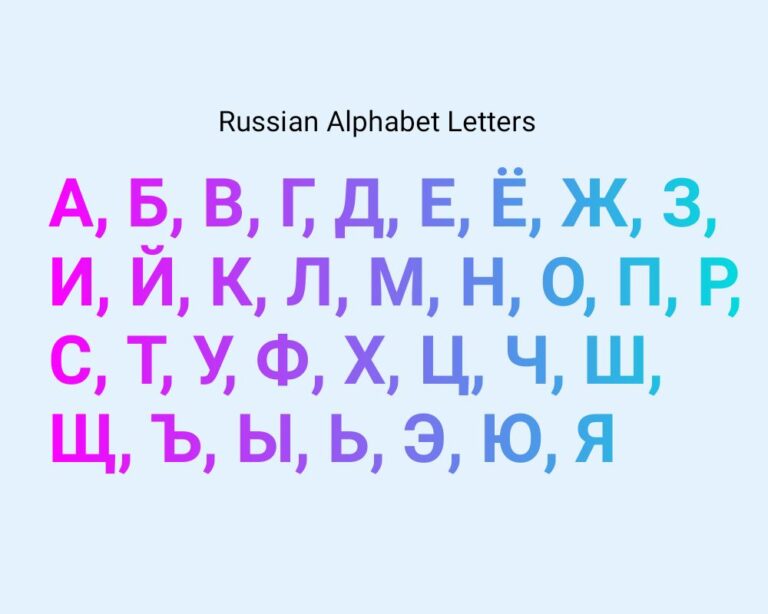
The Russian alphabet has 33 letters. The first letter of the alphabet is А (а), the second is Б (б), the third is В (в), and so on.
In conclusion, quickly learning the Russian Alphabet Names Of Letters can be done with simple tips. First, focus on one letter at a time. Second, make sure to practice regularly.
And third, feel free to ask for help when needed. With these tips in mind, you’ll be on your way to quickly learning the Russian Alphabet Names Of Letters in no time!
FAQs
If you want to learn the Russian Alphabet quickly, look at our FAQs section. This part of our website contains a question and answer-based content that will help you grasp the basics quickly.
Plus, we’ve added the most common queries to ensure you’re getting all the information you need. Please comment if you have any related queries. We’ll be happy to help!
Question (1) – What are the names of Russian letters?
Answer: Each letter has a specific name and pronunciation. For example, the letter А is called а-курсив (ah-koo-REE-vyef) and is pronounced like the “a” in “father.”
To help you get started, we’ve compiled a quick guide to some of the most common Russian letters and their pronunciations. With a little practice, you’ll be reading and writing like a native in no time!
Question (2) – What are the letters in the Russian alphabet called?
Answer: The Russian alphabet comprises 33 letters, each with a name and a pronunciation. The names of the letters are not always easy to remember, but they are very important for learning how to read and write in Russian.
Here are the names of the letters in the Russian alphabet: А, Б, В, Г, Д, Е, Ё, Ж, З, И, Й, К, Л, М, Н, О, П, Р, С, Т, У, Ф, Х, Ц, Ч, Ш, Щ,ъ ыь эюя.
Question (3) – Who uses the Russian alphabet?
Answer: Since the Cyrillic alphabet is used in many Slavic languages, it’s estimated that about 250 million people use it. The Russian alphabet is a variant of the Cyrillic alphabet and has been used since the 10th century.
It’s used by the Russian-speaking population, which comprises about 144 million people. The Russian alphabet is also used in some non-Slavic languages spoken in Russia, such as Tatars and Bashkir.
Question (4) – How many characters are in the Russian alphabet?
Answer: There are 33 characters in the Russian alphabet. The alphabet comprises 21 consonants, ten vowels, and two signs (the hard and soft).
The Cyrillic alphabet, used to write Russian, is derived from the Greek alphabet. It was created in the 9th century by St. Cyril, a missionary who wanted to spread Christianity in Slavic countries. The first version of the alphabet had 42 letters, but later it was reduced to 33.
Question (5) – Why does the Russian Alphabet have 33 Letters?
Answer: The Russian alphabet has 33 letters, which can seem like a lot compared to other languages. But there’s a reason for it – the extra letters represent different sounds common in Russian. This can be helpful for speakers of other languages who are trying to learn Russian, as it can make pronunciation easier.
And while it takes some time to get used to, the extra letters simplify reading and writing in Russian. So next time you’re overwhelmed by the Cyrillic alphabet, remember that it just takes a little practice to get used to – and you’ll be reading and writing like a native in no time.
Question (6) – What is the Russian alphabet in English?
Answer: There are 33 letters in the Russian alphabet. Some of these letters are the same as in English, but many differ. The Russian alphabet is also known as the Cyrillic alphabet.
The Russian alphabet has several letters that do not exist in English. For example, three extra consonants represent hard sounds that do not exist in English: Ч (ch), Ш (sh), and Щ (sch).
There is also a letter that represents the sound “zh” (Ж), which is similar to the “s” sound in English. In addition, there are two extra vowels: Ё (yo) and Э (e). These two letters represent sounds that do not exist in English.
Question (7) – What are the letters in the Russian alphabet called?
Answer: In Russian, the alphabet is called “азбука” (pronounced “az-BOO-kuh”). There are 33 letters in the Russian alphabet: 10 vowels, 21 consonants, and two signs (ь, ъ).
Vowels in the Russian alphabet are: а, е, ё, и, о, у, ы, э, ю, я. Consonants are б, в, г,д,ж,з,й,к,л,м,н,п,р,с,т,ф,х,ц,ч ш щ. The two signs are:ь (soft sign) and ъ (hard sign).
Question (8) – Why Does the Russian Alphabet Have Such Strange Names for Its Letters?
Answer: The Russian alphabet may seem strange to English speakers, but it makes much sense once you understand its history. The alphabet is called Cyrillic, named after the 9th-century missionary Saint Cyril. He and his brother, Saint Methodius, created the first Slavic alphabet based on the Greek alphabet.
Over time, the Russian alphabet has undergone several changes. Most notably, in 1708, Peter the Great issued an edict that changed the spelling of some words to make them more French. This helped Russia become more Westernized and modern.
Today, there are 33 letters in the Russian alphabet: 10 vowels, 21 consonants, and two signs (the hard and soft signs). Each letter has a name that corresponds to its sound.
Question (9) – Why Does the Russian Alphabet Have Different Names for Some of Its Letters?
Answer: The Russian alphabet is more complex than it may first appear. While there are only 33 letters in the alphabet, some of those letters have different names depending on where they appear in a word. This is not very clear for non-native speakers of Russian who are trying to learn the language.
So why does the Russian alphabet have different names for some of its letters? The answer has to do with the history of the Russian language and the way that words are pronounced in different contexts. For example, the letter “г” is pronounced differently at the beginning of a word than when it is in the middle or end of a word.
We provide accurate information on the Russian alphabet, including the names of letters and how to pronounce them.