
How Many Consonants In Russian Alphabet 2026

The Russian language is a linguistic treasure trove, filled with a rich and diverse range of sounds that captivate the senses and offer a profound auditory experience.
As we delve into its unique alphabet, one essential question arises: How many consonants does the Russian alphabet consist of in 2026?
The answer provides a fascinating insight into Slavic phonology! With 21 consonants—ranging from familiar sounds like p, s, and t to more intriguing ones like zh, sh, and ts—the Russian alphabet holds an abundance of phonetic wonders waiting to be explored.
Join us on this linguistic journey as we unravel the logic behind each consonant’s pronunciation and delve into the captivating world of Russian phonetics.
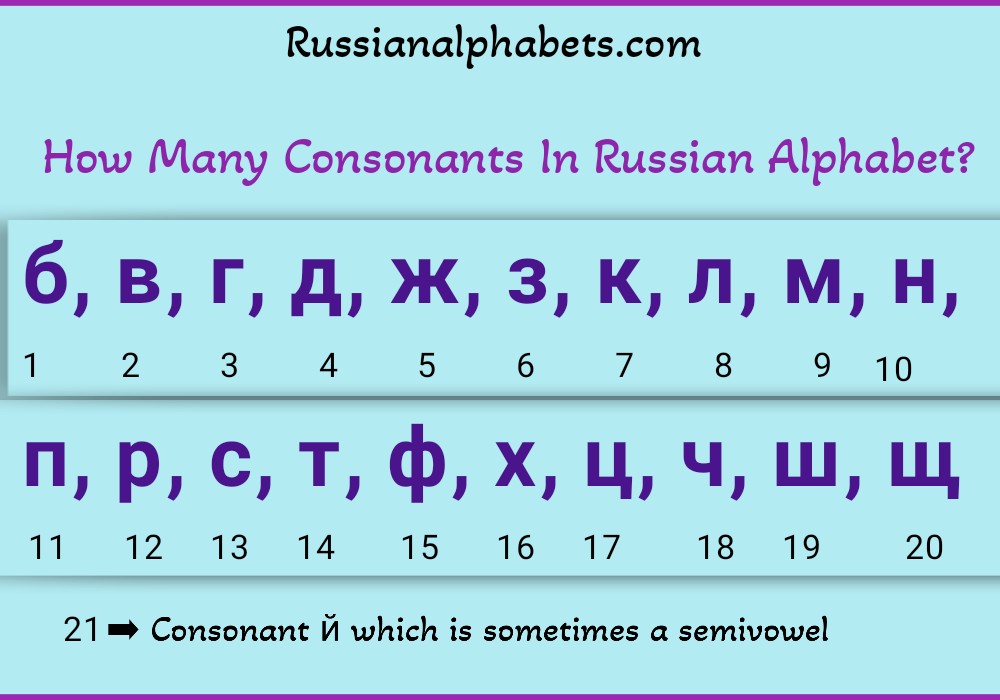
How Many Consonants In Russian Alphabet?
The modern Russian alphabet is comprised of 33 letters. It is a specialized adaptation of the Cyrillic script designed specifically to represent the unique sounds of the Russian language.
This systematic script consists of 10 vowel letters, 21 consonants, and two pronunciation signs that carry no sound of their own. Historically, the Cyrillic script replaced earlier systems like the Glagolitic alphabet to become the standard for Slavic literacy.
- Twenty-one Consonants – б, в, г, д, ж, з, к, л, м, н, п, р, с, т, ф, х, ц, ч, ш, щ, and й.
- Ten Vowels – а, э, ы, у, о, я, е, ё, ю, and и.
- Two Pronunciation Signs – the soft sign (ь) and the hard sign (ъ).
The 21 Consonants of the Russian Alphabet:
- Б (B) – Pronounced like the English “b” as in bat.
- В (V) – Similar to the English “v” as in van.
- Г (G) – Comparable to the “g” in go (always hard).
- Д (D) – Corresponding to the English “d” sound.
- Ж (Zh) – A unique sound, similar to the “s” in measure.
- З (Z) – Similar to the English “z” as in zoo.
- К (K) – Pronounced like the English “k” sound.
- Л (L) – Similar to the English “l” sound.
- М (M) – Comparable to the English “m” sound.
- Н (N) – Corresponding to the English “n” sound.
- П (P) – Pronounced like the English “p” sound.
- Р (R) – A rolled or trilled “r” sound.
- С (S) – Similar to the English “s” as in set.
- Т (T) – Comparable to the English “t” sound.
- Ф (F) – Pronounced like the English “f” sound.
- Х (Kh) – A guttural sound, similar to the “ch” in the Scottish loch.
- Ц (Ts) – Pronounced like the “ts” in sits.
- Ч (Ch) – Similar to the English “ch” as in chip.
- Ш (Sh) – Pronounced like the “sh” in shut.
- Щ (Shch) – An extended soft “sh” sound, like “fresh cheese.”
- Й (Y) – A semivowel, similar to the “y” in boy.
Each consonant is a fundamental pillar of the Russian language, determining the rhythm and clarity of communication. Understanding these sounds is the essential first step to achieving authentic Russian pronunciation.
The Structural Logic of Russian Consonants
The high count of consonants in Russian is a result of its highly inflected nature. Because Russian relies on a system of suffixes and case endings to change word meanings, a diverse consonant set is necessary to provide phonetic distinction between different grammatical forms.
For instance, a single root like “кот” (cat) can take various forms depending on its role in a sentence. The consonant structure ensures that these subtle shifts remain audible and clear to the listener.
The Fascinating Connection Between Cyrillic and Latin Scripts
While English uses 26 letters and Russian uses 33, there are deep historical connections between the two. The first half of the Russian alphabet features several letters that are visually identical to English (A, K, M, O, T), though others can be deceptive. For example, the Russian ‘В’ looks like ‘B’ but represents the ‘V’ sound.
Learning to navigate these “false friends” and unique Slavic characters is part of the exciting challenge of mastering Russian. Once you understand the logical sound assigned to each symbol, reading Russian becomes surprisingly straightforward.
Exploring the History and Evolution of Russian Phonemes
Russian consonants carry a rich history. Many characters were adapted from the Greek alphabet during the 9th century to accommodate Slavic sounds. For example, the letter Ж (zh) was introduced to represent a specific voiced sound that did not exist in the Greek or Latin systems of that time. Mastering these characters allows you to connect with centuries of literary and cultural tradition.
Conclusion Points
How Many Consonants In Russian Alphabet 2026? The Russian alphabet consists of 33 letters, providing a comprehensive framework for both print and cursive writing.
This includes 21 consonants and 10 vowels, along with the two modifier signs (ь and ъ). While mastering 33 characters may seem like a challenge, its phonetic consistency makes it a logical and rewarding system for any dedicated student.
In conclusion, with professional practice and consistent study, you can master the 21 consonants of the Russian language and begin communicating with the clarity of a native speaker.
FAQs
Explore our FAQ section to build a deeper understanding of Russian consonants, pronunciation, and the foundational rules of the language.
Question (1) – Exactly How Many Consonants Are In The Russian Alphabet?
Answer: There are exactly 21 consonant letters in the 33-letter Russian alphabet.
Question (2) – Are there more consonant sounds than letters in Russian?
Answer: Yes. While there are 21 consonant letters, they can represent approximately 36 different sounds depending on whether they are pronounced “hard” or “soft” (palatalized).
Question (3) – What is the function of a consonant in Russian phonetics?
Answer: A consonant is a sound produced by a partial or complete obstruction of airflow. In Russian, these are categorized into hard and soft pairs, which are essential for determining the meaning of words.
Question (4) – How many letters are in the Russian alphabet compared to English?
Answer: The Russian alphabet has 33 letters, whereas the English alphabet consists of 26 letters.
Question (5) – Are there silent letters in the Russian alphabet?
Answer: Yes, the Hard Sign (ъ) and the Soft Sign (ь) are silent modifiers. They do not represent a sound themselves but indicate how to pronounce the preceding consonant.
Stay updated with the latest linguistic insights on Russian consonants and their usage right here at Russianalphabets.com.


